

Skip to content

Introducing Intelligent Shift Collaboration, the latest enhancement to our Flexible Workforce Solution 

Stop Reacting to Staffing Gaps. Start Filling Them Earlier.

Healthcare organizations are under constant pressure to manage staffing volatility. Callouts, fragmented systems, and limited workforce visibility make it difficult to stay ahead. These challenges contribute to nearly $900 billion in total industry labor costs, with workforce expense now a top challenge to financial sustainability.  

Intelligent Shift Collaboration changes how resourcing decisions
are made.

It combines demand forecasting with real-time execution to fill shifts faster, reduce labor spend, eliminate manual effort, and create more equitable staffing models.

 
ChatGPT Image Mar 26, 2026, 04_57_14 PM
Computer

Reduce Frontline Leader Administrative Burden, Improve Staff Schedule Flexibility, and Manage Labor Expenses 

Intelligent Shift Collaboration enables healthcare organizations to move beyond reactive staffing by aligning workforce supply with real-time demand and enabling more proactive, workforce intelligence-driven scheduling decisions. 

By combining demand forecasting, intelligent insights, and AI-driven execution, it allows leaders to deploy the right resources at the right time, with greater consistency and control, while turning last-minute staffing changes into more informed, strategic actions. 

Embedding sophisticated intelligence capabilities within staff workflows supports flexible, equitable scheduling across: 

Icons-ICS-1

Demand Forecasting Identifies Coverage Risk
Before It Impacts the Schedule
 

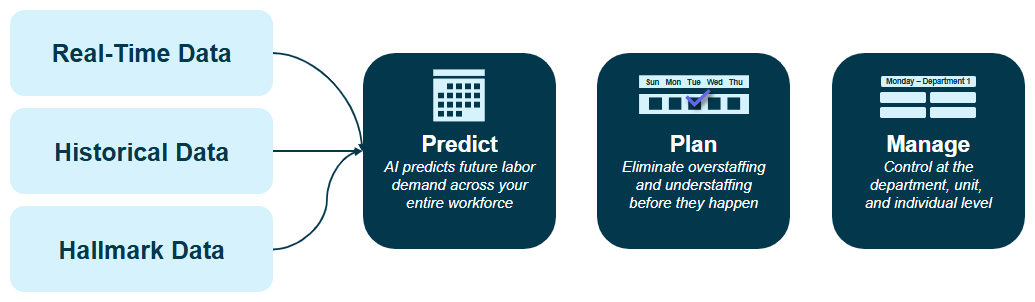
Demand forecasting uses historical staffing patterns, real-time operational data, and system-wide signals, built on Hallmark’s industry dataset finetuned with predictive insights, to prevent over and understaffing.

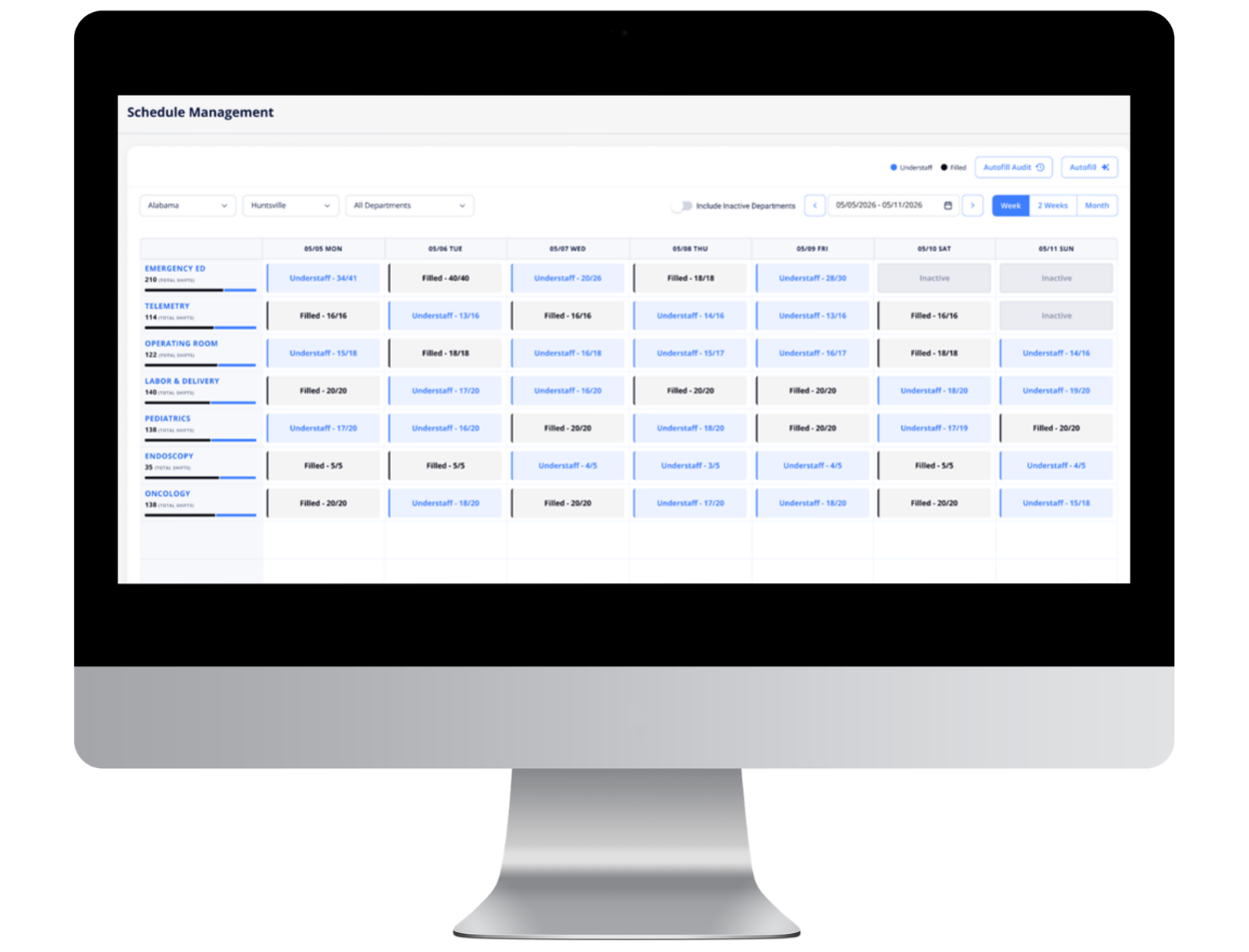
Leaders can view expected demand by unit, role, and timeframe, along with where coverage is at risk if no action is taken. This provides a forward-looking understanding of staffing needs, rather than relying on static schedules or retrospective reporting.

Updated Grapic

Fill Shifts Through Coordinated Execution

 Once a need is identified, staffing actions can be executed within the same system, without requiring manual coordination across multiple tools or communication channels. 

 Signal
Dynamic Shift Broadcasting 

Open shifts are distributed in real time to qualified resources. Multiple staffing sources (e.g., FTEs, float pools, contingent) can be activated simultaneously, expanding reach and improving response rates.

Using AI-driven autofill, clinicians are matched and assigned automatically based on availability, credentials, cost, skill mix, workforce type, and prior shift activity.

 
 Phone Icon-1
Mobile Workforce Experience

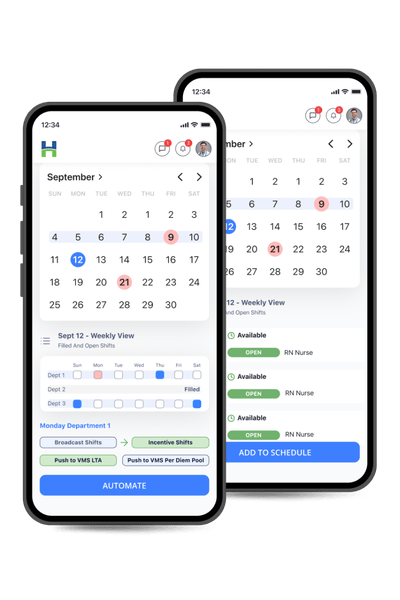
Staff interact with open shifts through a mobile experience designed for immediate response.

They can view opportunities across departments and locations, update availability, and accept, swap, or split shifts directly.
 Guard icon
Guardrails and Scheduling Controls 

All assignments are governed by built-in rules that enforce role eligibility, credential requirements, and organizational policies.

Overtime thresholds and compliance constraints are applied automatically, ensuring that shifts are filled appropriately while maintaining consistency across teams.
AI Graphic

Improve Staffing Outcomes Through Continuous
AI Learning 

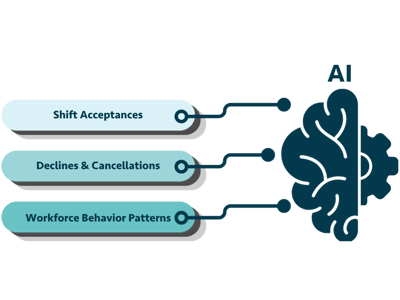
Intelligent Shift Collaboration uses AI to continuously refine how resourcing decisions are made.

By learning from workforce activity over time, it identifies patterns in preferences and work behavior to more accurately fill open opportunities while continuously improving future staffing recommendations.

The result? Better alignment between workforce supply and demand.

See Intelligent Shift Collaboration in Action

Screenshot 2026-03-27 114914